PROGNOSTIC VALUE OF SERUM THYROGLOBULIN KINETICS FOR PREDICTING RECURRENCE IN DIFFERENTIATED THYROID CANCER
DOI:
https://doi.org/10.55374/jseamed.v10.290Keywords:
thyroid cancer, thyroglobulin, recurrence, thyroglobulin doubling-time, thyroglobulin velocityAbstract
Background: Although absolute serum thyroglobulin (Tg) levels are routinely used to monitor differentiated thyroid cancer (DTC), a single measurement may not accurately predict disease progression in patients who have already achieved remission. While Tg kinetics have shown prognostic value, the optimal thresholds for detecting early recurrence in this specific excellent-response population remain poorly defined.
Objectives: The study aimed to evaluate the usefulness of serum thyroglobulin doubling time (Tg-DT) and thyroglobulin velocity (TgV) during thyroid-stimulating hormone (TSH) suppression for predicting tumor recurrence among patients with DTC who achieved remission.
Methods: This retrospective study analyzed 270 patients with DTC who underwent total/near-total thyroidectomy followed by radioactive iodine (RAI) ablation at Siriraj Hospital between January 2007 and December 2011. Eligible patients had achieved remission (Tg < 1 ng/mL with negative imaging) and had ≥ 4 Tg measurements obtained during TSH suppression. Tg-DT and TgV was calculated using non-linear regression and linear formulas, respectively.
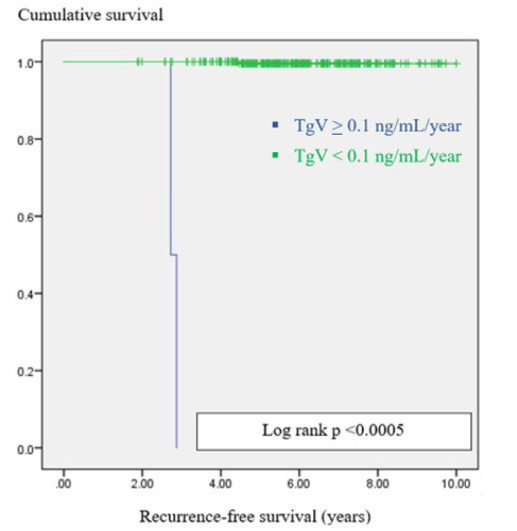
Results: During the follow-up period, three patients (1.1%) experienced disease recurrence. Receiver operating characteristic analysis tentatively identified optimal exploratory cutoffs as Tg-DT ≤ 1 year and TgV ≥ 0.1 ng/mL/year. At these specific thresholds, both markers predicted recurrence with a sensitivity of 66.7% (95% CI: 9.4% -99.2%), a specificity of 100% (95% CI: 98.6% - 100%), and an overall accuracy of 99.6% (95% CI: 97.9% -99.9%). These high estimates should be interpreted with caution, given the wide confidence intervals resulting from the low event rate. Nominally shorter mean recurrence-free survival was observed among patients exceeding these thresholds compared to those below (2.8 years [95% CI: 2.6 -2.9] vs. 9.9 years [95% CI: 9.9 -10.0]; p < 0.0005).
Conclusion: Within this cohort, a Tg-DT ≤ 1 year and a TgV ≥ 0.1 ng/mL/year were associated with disease recurrence and may serve as highly specific preliminary indicators during remission. However, given the low number of recurrence events inherently observed in excellent-response patients, these kinetic markers should be interpreted as preliminary tools that complement, rather than replace, comprehensive clinical surveillance. Larger-scale studies are required to validate their routine clinical applicability.
Downloads
Metrics
References
Haugen BR, Alexander EK, Bible KC, Doherty GM, Mandel SJ, Nikiforov YE, et al. 2015 American Thyroid Association Management Guidelines for adult patients with thyroid nodules and differentiated thyroid cancer: The American Thyroid Association Guidelines Task Force on thyroid nodules and differentiated thyroid cancer. Thyroid 2016; 26: 1-133. DOI: https://doi.org/10.1089/thy.2015.0020
Mazzaferri EL, Kloos RT. Clinical review 128: Current approaches to primary therapy for papillary and follicular thyroid cancer. J Clin Endocrinol Metab 2001; 86: 1447-63. DOI: https://doi.org/10.1210/jcem.86.4.7407
Miyauchi A, Kudo T, Miya A, Kobayashi K, Ito Y, Takamura Y, et al. Prognostic impact of serum thyroglobulin doubling-time under thyrotropin suppression in patients with papillary thyroid carcinoma who underwent total thyroidectomy. Thyroid 2011; 21: 707- 16. DOI: https://doi.org/10.1089/thy.2010.0355
Wong H, Wong KP, Yau T, Tang V, Leung R, Chiu J, et al. Is there a role for unstimulated thyroglobulin velocity in predicting recurrence in papillary thyroid carcinoma patients with detectable thyroglobulin after radioiodine ablation? Ann Surg Oncol 2012; 19: 3479-85. DOI: https://doi.org/10.1245/s10434-012-2391-6
Giovanella L, Garo ML, Albano D, Görges R, Ceriani L. The role of thyroglobulin doubling time in differentiated thyroid cancer: a meta-analysis. Endocr Connec 2022; 11: e210648. DOI: https://doi.org/10.1530/EC-21-0648
Iwasaki H, Yamazaki H, Takasaki H, Suganuma N, Sakai R, Nakayama H, et al. Treatment outcomes of differentiated thyroid cancer with distant metastasis improve by tyrosine kinase inhibitors. Oncol Lett 2019; 17: 5292- 300. DOI: https://doi.org/10.3892/ol.2019.10180
Chiewvit S, Chiewvit P, Keskool P. Evaluation of factors associated with recurrent differentiated thyroid cancer in patients who underwent total thyroidectomy and radioiodine therapy with biochemical incomplete responses. J Med Assoc Thailand 2025; 108. DOI: https://doi.org/10.35755/jmedassocthai.2025.6.440-447-02087
Giovanella L, Keller F, Ceriani L, Tozzoli R. Heterophile antibodies may falsely increase or decrease thyroglobulin measurement in patients with differentiated thyroid carcinoma.Clin Chem Lab Med 2009; 47: 952-4. DOI: https://doi.org/10.1515/CCLM.2009.230
Verburg FA, Wäschle K, Reiners C, Giovanella L, Lentjes EGWM. Heterophile antibodies rarely influence the measurement of thyroglobulin and thyroglobulin antibodies in differentiated thyroid cancer patients. Horm Metab Res 2010; 42: 736-9. DOI: https://doi.org/10.1055/s-0030-1254132
Ringel MD, Sosa JA, Baloch Z, Bischoff L, Bloom G, Brent GA, et al. 2025 American Thyroid Association Management Guidelines for adult patients with differentiated thyroid cancer. Thyroid 2025; 35: 841-985. DOI: https://doi.org/10.1177/10507256251363120
Downloads
Published
How to Cite
Issue
Section
License
Copyright (c) 2026 Journal of Southeast Asian Medical Research

This work is licensed under a Creative Commons Attribution-NonCommercial-NoDerivatives 4.0 International License.
The Journal of Southeast Asian Medical Research will hold the copyright to all published articles. The publisher's production department handles copyright forms once a manuscript is accepted and scheduled for publication.