THE PROGNOSTIC SIGNIFICANCE OF TUMOR-INFILTRATING LYMPHOCYTES IN RESECTABLE TRIPLE-NEGATIVE BREAST CANCER—INSIGHTS FROM SEVEN YEARS OF REAL-WORLD DATA
DOI:
https://doi.org/10.55374/jseamed.v10.255Keywords:
triple-negative breast cancer, tumor-infiltrating lymphocytes (TILs), prognosis, relapse-free survival, breast cancer-specific survival, Southeast Asia, ThailandAbstract
Background: Triple-negative breast cancer (TNBC) is an aggressive subtype with limited treatment options and a high risk of recurrence. Tumor-infiltrating lymphocytes (TILs) are potential prognostic markers of TNBC. While studies in Western populations suggest favorable outcomes with higher TIL levels, evidence from Southeast Asian populations remains limited. Objectives: This study aimed to evaluate the prognostic impact of TIL levels on survival outcomes in patients with resectable TNBC.
Methods: We retrospectively reviewed patients with resectable TNBC who underwent upfront surgery at the Ramathibodi Comprehensive Cancer Center in Thailand between 2015 and 2019. All patients were staged according to the AJCC 8th edition. TILs were assessed using the International TILs Working Group 2014 guidelines. The patients were categorized by TIL levels. The primary endpoint was relapse-free survival (RFS), and patients with TILs ≥30% were compared with those with TILs <30%. Secondary endpoints included RFS with TILs cutoffs (≥ 10% and ≥20%), breast cancer-specific survival (BCSS), and overall survival (OS).
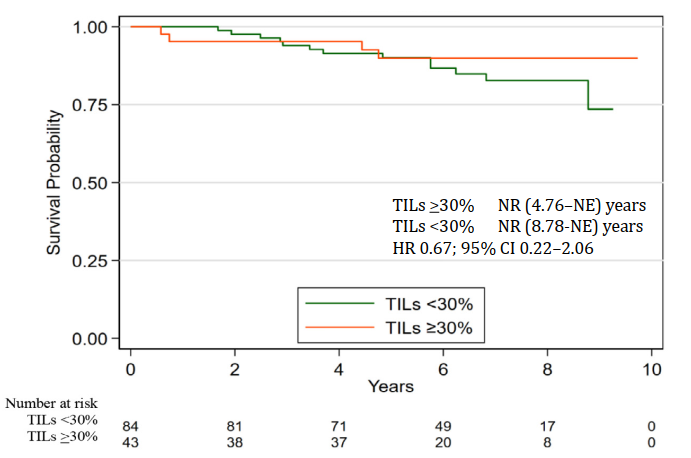
Results: The study included 128 patients with a median follow-up of 83 months. Adjuvant chemotherapy was administered in 84.4% of cases, whereas omission was mainly in older or comorbid patients. Patients with TILs ≥30% showed a favorable but non-significant trend toward improved RFS (HR 0.54; 95% CI, 0.20–1.49; p = 0.238), BCSS (HR 0.43; 95% CI, 0.09–1.97), and OS (HR 0.67; 95% CI, 0.22–2.06). Lower TIL thresholds (≥10%, ≥20%) were not associated with improved outcomes. A multivariate analysis showed no independent prognostic effect of TILs.
Conclusion: Although statistical significance was not reached, TIL levels ≥30% were associated with a favorable survival trend. To our knowledge, this is the largest Southeast Asian cohort with long-term follow-up, providing region-specific real-world evidence. These findings illustrate that TIL assessment on routine H&E slides is feasible and practical, especially in resource-constrained settings, and highlight the need for larger prospective studies to clarify the prognostic and predictive role of TILs in the immunotherapy era.
Downloads
Metrics
References
Srimuninnimit V, Chaiyapan W, Thiravud K, Waisayarat J, Thongyoo P, Leelarungrayub N, et al. Real-life clinical pattern, management, and survival in Thai patients with early-stage or metastatic triple-negative breast cancer. PLOS ONE 2018; 13: e0209040. DOI: https://doi.org/10.1371/journal.pone.0209040
Loibl S, Poortmans P, Morrow M, Denkert C, Curigliano G. Breast cancer. Lancet 2021; 397: 1750–69. DOI: https://doi.org/10.1016/S0140-6736(20)32381-3
Foulkes WD, Smith IE, Reis-Filho JS. Triplenegative breast cancer. New Engl J Med 2010; 363. DOI: https://doi.org/10.1056/NEJMra1001389
Jiang YZ, Ma D, Suo C, Shi J, Xue M, Hu X, et al. Genomic and transcriptomic landscape of triple-negative breast cancers: subtypes and treatment strategies. Cancer Cell 2019; 35: 428–40.e5.
Burstein MD, Tsimelzon A, Poage GM, Covington KR, Contreras A, Fuqua SA, et al. Comprehensive genomic analysis identifies novel subtypes and targets of triple-negative breast cancer. Clin Cancer Res 2015; 21: 1688-98. DOI: https://doi.org/10.1158/1078-0432.CCR-14-0432
Bareche Y, Venet D, Ignatiadis M, Aftimos P, Piccart M, Rothe F, et al. Unravelling triple-negative breast cancer molecular heterogeneity using an integrative multiomic analysis. Ann Oncol 2018; 29: 895-902. DOI: https://doi.org/10.1093/annonc/mdy024
Marra A, Trapani D, Viale G, Criscitiello C, Curigliano G.Practical classification of triplenegative breast cancer: intratumoral heterogeneity, mechanisms of drug resistance, and novel therapies. NPJ Breast Cancer 2020; 6: 54. DOI: https://doi.org/10.1038/s41523-020-00197-2
Bianchini G, De Angelis C, Licata L, Gianni L. Treatment landscape of triple-negative breast cancer: expanded options and evolving needs. Nat Rev Clin Oncol 2022; 19: 91–113. DOI: https://doi.org/10.1038/s41571-021-00565-2
Salgado R, Denkert C, Demaria S, Sirtaine N, Klauschen F, Pruneri G, et al. The evaluation of tumor-infiltrating lymphocytes (TILs) in breast cancer: recommendations by an International TILs Working Group 2014. Ann Oncol 2015; 26: 259-71.
Goto W, Kawaguchi K, Nagao T, Koyama H, Kitano S, Miyashita M, et al. Predictive value of improvement in the immune tumour microenvironment in patients with breast cancer treated with neoadjuvant chemotherapy. ESMO Open 2018; 3: e000305. DOI: https://doi.org/10.1136/esmoopen-2017-000305
Asano Y, Kobayashi S, Yamashita T, Sueta A, Takao S, Nomura Y, et al. Prediction of treatment response to neoadjuvant chemotherapy in breast cancer by subtype using tumor-infiltrating lymphocytes. Anticancer Res 2018; 38: 2311-21. DOI: https://doi.org/10.21873/anticanres.12476
Ruan M, Zhao X, Li W, Shi W, Wang Y, Cao S. Predictive value of tumor-infiltrating lymphocytes to pathological complete response in neoadjuvant treated triple-negative breast cancers. Diagn Pathol 2018; 13. DOI: https://doi.org/10.1186/s13000-018-0743-7
Loi S, Drubay D, Adams S, Pruneri G, Francis PA, Lacroix-Triki M, et al. Tumor-infiltrating lymphocytes and prognosis in early-stage triple-negative breast cancer: a pooled analysis. J Clin Oncol 2019; 37: 559–69. DOI: https://doi.org/10.1200/JCO.18.01010
de Jong VMT, Wang Y, Ter Hoeve ND, Opdam M, Stathonikos N, Jóźwiak K, et al. Prognostic value of stromal tumor-infiltrating lymphocytes in young, node-negative, triple-negative breast cancer without systemic therapy. J Clin Oncol 2022; 40: 2361–74. DOI: https://doi.org/10.1200/JCO.21.01536
Denkert C, von Minckwitz G, Darb-Esfahani S, Lederer B, Heppner BI, Weber KE, et al. Tumor-infiltrating lymphocytes and prognosis in breast cancer subtypes: a pooled analysis of 3,771 patients. Lancet Oncol 2018; 19: 40-50. DOI: https://doi.org/10.1016/S1470-2045(17)30904-X
El Bairi K, Haynes HR, Blackley E, Fineberg S, Shear J, Turner S, et al. The tale of TILs in breast cancer: A report from The International Immuno-Oncology Biomarker Working Group. NPJ Breast Cancer 2021; 7: 150. DOI: https://doi.org/10.1038/s41523-021-00346-1
Salgado R, Denkert C, Demaria S, Sirtaine N, Klauschen F, Pruneri G, et al. The evaluation of tumor-infiltrating lymphocytes (TILs) in breast cancer: recommendations by an International TILs Working Group 2014. Ann Oncol 2015; 26: 259-71. DOI: https://doi.org/10.1093/annonc/mdu450
Suwannaphoom K SS, Wiwatwarayos K, Seneetuntigul P, Julimasart P. Assessing the relationship between tumor-infiltrating lymphocytes and PD-L1 expression in triple negative breast cancer: Identifying optimal TILs cut-off value for pathologic reporting. Ann Diag Pathol 2024; 70: 152294. DOI: https://doi.org/10.1016/j.anndiagpath.2024.152294
Leon-Ferre RA, Jonas SF, Salgado R, Loi S, de Jong V, Carter JM, et al. Tumor-infiltrating lymphocytes in triple-negative breast cancer. JAMA Oncol 2024; 331: 1135–44. DOI: https://doi.org/10.1001/jama.2024.3056
Geurts VCM, Balduzzi S, Steenbruggen TG, Linn SC, Siesling S, Badve SS, et al. Tumor-infiltrating lymphocytes in stage I triple-negative breast cancer untreated with chemotherapy. JAMA Oncol 2024; 10: 1077– 86. DOI: https://doi.org/10.1001/jamaoncol.2024.1917
Tramm T, Di Caterino T, Jylling AB, Lelkaitis G, Lænkholm AV, Ragó P, et al. Standardized assessment of tumor-infiltrating lymphocytes in breast cancer: an evaluation of inter-observer agreement between pathologists. Acta Oncol 2017; 56: 1067-73.
Huertas-Caro CA RM, Rey-Vargas L, Bejarano-Rivera LM, Ballen DF, Nuñez M, Mejía JC, et al. Tumor infiltrating lymphocytes (TILs) are a prognosis biomarker in Colombian patients with triple negative breast cancer. Sci Rep 2023; 13. DOI: https://doi.org/10.1038/s41598-023-48300-4
Park HS, Heo I, Kim JY, Kim S, Nam S, Park S, et al. No effect of tumor-infiltrating lymphocytes (TILs) on prognosis in patients with early triple-negative breast cancer: Validation of recommendations by the International TILs Working Group 2014. J Surg Oncol 2016; 114: 17-21. DOI: https://doi.org/10.1002/jso.24275
Savas P, Salgado R, Denkert C, Sotiriou C, Darcy PK, Smyth MJ, et al. Clinical relevance of host immunity in breast cancer: from TILs to the clinic. Nat Rev Clin Oncol2016; 13: 228-41. DOI: https://doi.org/10.1038/nrclinonc.2015.215
Gao G, Wang Z, Qu X, Zhang Z. Prognostic value of tumor-infiltrating lymphocytes in patients with triple-negative breast cancer: a systematic review and meta-analysis. BMC Cancer 2020; 20: 179. DOI: https://doi.org/10.1186/s12885-020-6668-z
Jang N, Kwon HJ, Park MH, Kang SH, Bae YK. Prognostic value of tumor-infiltrating lymphocyte density assessed using a standardized method based on molecular subtypes and adjuvant chemotherapy in invasive breast cancer. Ann Surg Oncol 2018; 25: 937-46. DOI: https://doi.org/10.1245/s10434-017-6332-2
Gu-Trantien C, Loi S, Garaud S, Equeter C, Libin M, de Wind A, et al. CD4⁺ follicular helper T cell infiltration predicts breast cancer survival. J Clin Invest 2013; 123: 2873-92. DOI: https://doi.org/10.1172/JCI67428
Yu X, Zhang Z, Wang Z, Wu P, Qiu F, Huang J. Prognostic and predictive value of tumorinfiltrating lymphocytes in breast cancer: a systematic review and meta-analysis. Clin Transl Oncol 2016; 18: 497-506. DOI: https://doi.org/10.1007/s12094-015-1391-y
Stanton SE, Disis ML. Clinical significance of tumor-infiltrating lymphocytes in breast cancer. J ImmunoTher Cancer 2016; 4: 59. DOI: https://doi.org/10.1186/s40425-016-0165-6
Ibrahim EM, Al-Foheidi ME, Al-Mansour MM, Kazkaz GA. The prognostic value of tumor-infiltrating lymphocytes in triple-negative breast cancer: A meta-analysis. Breast Cancer Res Treat 2014; 148: 467-76. DOI: https://doi.org/10.1007/s10549-014-3185-2
Dulgar O, Ilvan S, Turna ZH. Prognostic factors and tumor infiltrating lymphocytes in triple negative breast cancer. Eur J Breast Health 2020; 16: 276-81. DOI: https://doi.org/10.5152/ejbh.2020.5305
Dieci MV, Tsvetkova V, Orvieto E, Piacentini F, Ficarra G, Griguolo G, et al. Immune characterization of breast cancer metastases: prognostic implications. BMC Cancer 2020; 20: 256. DOI: https://doi.org/10.1186/s13058-018-1003-1
de Moraes FCA, Souza MEC, Sano VKT, Moraes RA, Melo AC. Association of tumor-infiltrating lymphocytes with clinical outcomes in patients with triple-negative breast cancer receiving neoadjuvant chemotherapy: a systematic review and meta-analysis. Clin Transl Oncol. 2025; 27: 974-87. DOI: https://doi.org/10.1007/s12094-024-03661-8
Hoang H, Phung H, Tung NN, Dinh TN, Nguyen T, Nguyen T. The role of tumor-infiltrating lymphocytes in triple-negative breast cancer in Vietnam. International Journal of Gynecologic Cancer 2023; 33(Suppl 3): A87-A8. DOI: https://doi.org/10.1136/ijgc-2023-IGCS.151
Han E, Choi HY, Kwon HJ, Chung YR, Shin HC, Kim EK, et al. Characterization of tumor-infiltrating lymphocytes and their spatial distribution in triple-negative breast cancer. Breast Cancer Res. 2024; 26: 180. DOI: https://doi.org/10.1186/s13058-024-01932-4
Shen Y, Peng X, Shen C. Identification and validation of immune-related lncRNA prognostic signature for breast cancer. Genomics 2020; 112: 2640-6. DOI: https://doi.org/10.1016/j.ygeno.2020.02.015
Downloads
Additional Files
Published
How to Cite
Issue
Section
License
Copyright (c) 2026 Journal of Southeast Asian Medical Research

This work is licensed under a Creative Commons Attribution-NonCommercial-NoDerivatives 4.0 International License.
The Journal of Southeast Asian Medical Research will hold the copyright to all published articles. The publisher's production department handles copyright forms once a manuscript is accepted and scheduled for publication.