FACTORS INFLUENCING RESIDENT SATISFACTION IN DIAGNOSTIC RADIOLOGY TRAINING AT PHRAMONGKUTKLAO HOSPITAL
DOI:
https://doi.org/10.55374/jseamed.v10.277Keywords:
radiology residents, diagnostic radiology, residency training, residency satisfaction, medical educationAbstract
Background: Resident satisfaction is an important indicator of the quality and effectiveness of diagnostic radiology training programs. It reflects multiple aspects of education, including curriculum structure, clinical exposure, supervision, workload, learning environment, and resident well-being. Understanding the factors that influence satisfaction is important for continuous program improvement of the diagnostic radiology residency program at Phramongkutklao Hospital. However, data regarding resident satisfaction and training experiences within this institutional context remain limited.
Objectives: This study aimed to evaluate factors associated with satisfaction among diagnostic radiology residents and program alumni at Phramongkutklao Hospital.
Methods: This cross-sectional study used a self-administered online questionnaire distributed to current diagnostic radiology residents and program alumni at Phramongkutklao Hospital. The questionnaire comprised Likert-scale items and open-ended questions and was validated through expert review. We performed descriptive and comparative statistical analyses and analyzed qualitative responses thematically.
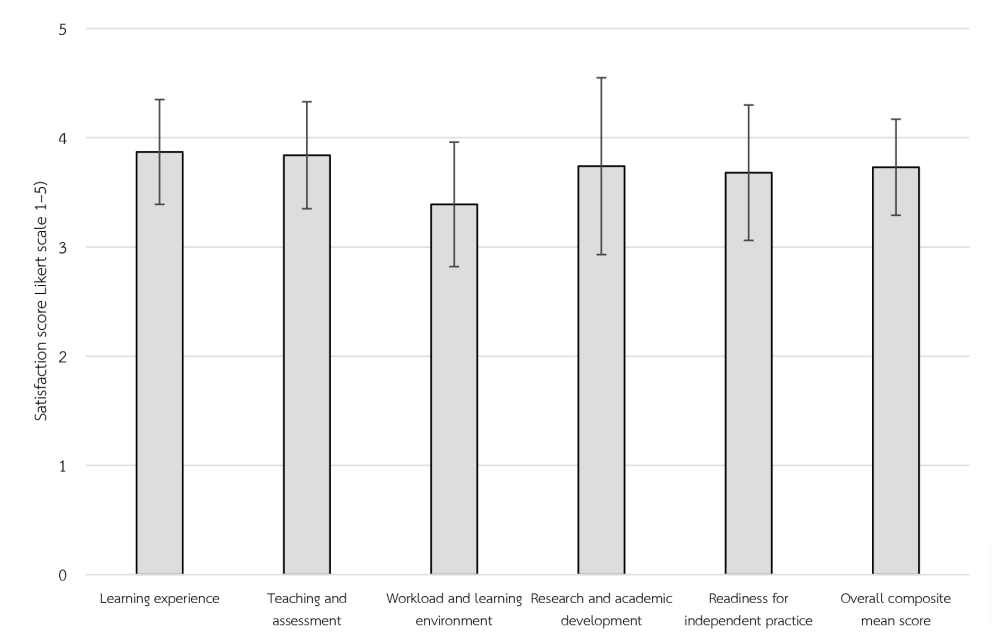
Results: Thirty-seven residents and program alumni completed the questionnaire. Overall satisfaction with residency training was high (mean, 3.73 ± 0.44), with the highest ratings for learning experience and teaching, and the lowest for workload and learning environment. Overall satisfaction was significantly correlated with confidence in recommending the program (r = 0.595, p < 0.001). Qualitative responses highlighted workload imbalance, limited research support, and gaps in specific clinical skills.
Conclusion: Diagnostic radiology residents and program alumni reported high overall satisfaction with training; however, workload, learning environment, and research support were identified as key areas for improvement. Resident satisfaction was strongly associated with willingness to recommend the program, supporting its role as an indicator of training quality and program effectiveness.
Downloads
References
Imanaka Y. Visualization and improvement of the quality, efficiency, and equity of the healthcare system: secondary publication. JMA J 2024; 7: 147-52. DOI: https://doi.org/10.31662/jmaj.2023-0196
Starfield B, Shi L, Macinko J. Contribution of primary care to health systems and health. Milbank Q 2005; 83: 457-502. DOI: https://doi.org/10.1111/j.1468-0009.2005.00409.x
Thimbleby H. Technology and the future of healthcare. J Public Health Res 2013; 2: e28. DOI: https://doi.org/10.4081/jphr.2013.e28
Balmer JT. The transformation of continuing medical education (CME) in the United States. Adv Med Educ Pract 2013; 4: 171-82. DOI: https://doi.org/10.2147/AMEP.S35087
European Society of Anaesthesiology and Intensive Care. Enhancing patient safety through medical education: a crucial imperative [Internet]. Brussels: ESAIC; [cited 2025 Feb 14]. Available from: https://esaic.org/enhancing-patient-safety-through-medicaleducation-a-crucial-imperative/
Zhu H, Zhang C, Li N, Yang Z, Qian X, Ji M, et al. Satisfaction survey on graduates of standardized training for resident doctors in Guizhou Province, China. BMJ Open 2024; 14: e085789. DOI: https://doi.org/10.1136/bmjopen-2024-085789
Heppe D, Baduashvili A, Limes JE, Suddarth K, Mann A, Gottenborg E, et al. Resident burnout, wellness, professional development, and engagement before and after new training schedule implementation. JAMA Netw Open 2024; 7: e240037. DOI: https://doi.org/10.1001/jamanetworkopen.2024.0037
Chuented P, Puranitee P, Pakakasama S, Meepanya S. Factors affecting residents’ internal motivation, grit, and well-being. BMC Med Educ 2023; 23: 779. DOI: https://doi.org/10.1186/s12909-023-04679-2
Hoff TJ, Pohl H, Bartfield J. Creating a learning environment to produce competent residents: the roles of culture and context. Acad Med 2004; 79: 532-40. DOI: https://doi.org/10.1097/00001888-200406000-00007
Lam, CZ, Nguyen HN, Ferguson EC. Radiology residents’ satisfaction with their training and education in the United States: Effect of program directors, teaching faculty, and other factors on program success. Am J Roentgenol 2016; 206: 907-16. DOI: https://doi.org/10.2214/AJR.15.15020
Zhang J, Han X, Yang Z, Wang Z, Zheng J, Yang Z, et al. Radiology residency training in China: results from the first retrospective nationwide survey. Insights Imaging 2021; 12: 25. DOI: https://doi.org/10.1186/s13244-021-00970-2
Garson A Jr, Levin SA. Ten 10-year trends for the future of healthcare: implications for academic health centers. Ochsner J 2001; 3: 10-5.
Lungren MP, Horvath JJ, Welling RD, Azene EM, Starikovsky A, Bashir MR, et al. Global health training in radiology residency programs. Acad Radiol 2011; 18: 782-91. DOI: https://doi.org/10.1016/j.acra.2011.02.009
Wayne WD. Biostatistics: A Foundation of Analysis in the Health Sciences. 6th edition New York: John Wiley & Sons, Inc, 1995. p.180.
Kaewkungwal J, Singhasivanon P. Sample size determination in clinical research. In: Pitisuttithum P, Picheansoonthon C, editors. Textbook of Clinical Research. 4th edition. Bangkok: Faculty of Tropical Medicine, Mahidol University; 2013.
Downloads
Published
How to Cite
Issue
Section
License
Copyright (c) 2026 Journal of Southeast Asian Medical Research

This work is licensed under a Creative Commons Attribution-NonCommercial-NoDerivatives 4.0 International License.
The Journal of Southeast Asian Medical Research will hold the copyright to all published articles. The publisher's production department handles copyright forms once a manuscript is accepted and scheduled for publication.