ASSOCIATION BETWEEN LOW PEAK INSPIRATORY FLOW RATE AND ACUTE EXACERBATION OF CHRONIC OBSTRUCTIVE PULMONARY DISEASE IN RECENTLY HOSPITALIZED PATIENTS
DOI:
https://doi.org/10.55374/jseamed.v10.273Keywords:
Chronic obstructive pulmonary disease, Peak inspiratory flow rate, Acute exacerbation, Dry powder inhalerAbstract
Introduction: Peak inspiratory flow rate (PIFR) is an important determinant of effective drug delivery with dry powder inhalers in patients with chronic obstructive pulmonary disease (COPD). Reduced PIFR is frequently observed following acute exacerbations of COPD (ECOPD), but its role in predicting early post-discharge re-exacerbation remains incompletely defined.
Methods: This prospective cohort study enrolled patients aged ≥40 years who were hospitalized for ECOPD at a tertiary hospital in Thailand between October 2024 and June 2025. PIFR was measured at hospital discharge using the In-Check Dial G16 device (Clement Clarke International, Harlow, UK) configured to a medium-resistance DPI setting. Suboptimal PIFR was defined as <60 L/min. The primary outcome was time to first moderate-to-severe COPD re-exacerbation within 56 days, evaluated by Kaplan–Meier and Cox proportional hazards analyses. The secondary outcome was the incidence of moderate-to-severe re-exacerbation within 56 days, evaluated by logistic regression with modified Poisson regression as a sensitivity analysis.
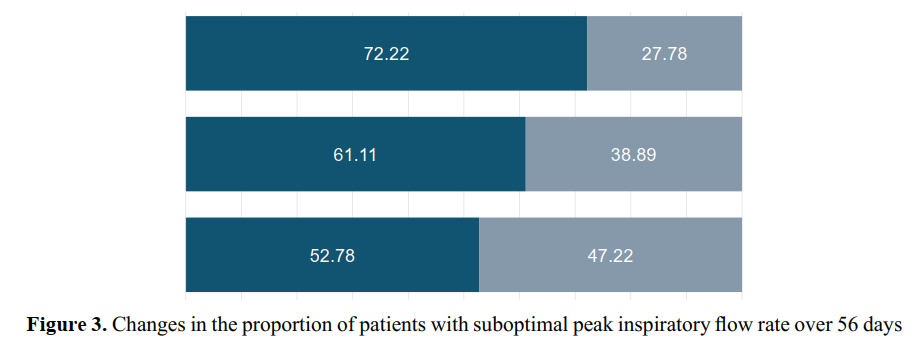
Results: Of 41 enrolled patients, 36 were included in the final analysis (mean age 66.4 years; all male), of whom 17 (47.2%) had suboptimal PIFR at discharge. During 56 days of follow-up, moderate-tosevere re-exacerbations occurred in 35.3% of patients with PIFR <60 L/min, compared with 5.3% in those with PIFR ≥60 L/min. Time-to-event analysis demonstrated a higher and earlier risk of re-exacerbation in the suboptimal PIFR group (log-rank p=0.024), with an adjusted hazard ratio of 13.52 (95% CI 1.14–159.93). Schoenfeld residuals confirmed the proportional hazards assumption. For the 56-day secondary outcome, suboptimal PIFR was associated with increased odds of re-exacerbation in univariable logistic regression (OR 9.82, 95% CI 1.04–92.78; p=0.046); the corresponding unadjusted risk ratio from modified Poisson regression was 6.71 (95% CI 0.90–50.22; p=0.064). PIFR improved over time in the overall cohort; however, patients who experienced re-exacerbation showed persistently lower or unstable PIFR trajectories.
Conclusion: Suboptimal PIFR at hospital discharge was associated with an increased risk of early COPD re-exacerbation. Assessment of PIFR may help identify patients at higher risk during the post-discharge period and support more individualized inhaler management strategies.
Downloads
Metrics
References
Venkatesan P. GOLD COPD report: 2025 update. Lancet Respir Med. 2025; 13: e7-e8. DOI: https://doi.org/10.1016/S2213-2600(24)00413-2
Wedzicha JA, Seemungal TA. COPD exacerbations: defining their cause and prevention. Lancet 2007; 370: 786-96 DOI: https://doi.org/10.1016/S0140-6736(07)61382-8
Hurst JR, Vestbo J, Anzueto A, Locantore N, Müllerova H, Tal-Singer R, et al. Susceptibility to exacerbation in chronic obstructive pulmonary disease. N Engl J Med 2010; 363: 1128-38. DOI: https://doi.org/10.1056/NEJMoa0909883
Lavorini F, Magnan A, Dubus JC, Voshaar, Corbetta L, Broeders M, et al. Effect of incorrect use of dry powder inhalers on management of patients with asthma and COPD. Respir Med 2008; 102: 593-604. DOI: https://doi.org/10.1016/j.rmed.2007.11.003
Mahler 5DA, Halpin DMG. Peak Inspiratory Flow as a Predictive Therapeutic Biomarker in COPD. Chest 2021; 160: 491-8. DOI: https://doi.org/10.1016/j.chest.2021.03.049
Leving MT, Kocks J, Bosnic-Anticevich S, Dekhuijzen R, Usmani OS. Relationship between Peak Inspiratory Flow and Patient and Disease Characteristics in Individuals with COPD-A Systematic Scoping Review. Biomedicines 2022; 10. DOI: https://doi.org/10.3390/biomedicines10020458
Duarte AG, Tung L, Zhang W, Hsu ES, Kuo YF, Sharma G. Spirometry Measurement of Peak Inspiratory Flow Identifies Suboptimal Use of Dry Powder Inhalers in Ambulatory Patients with COPD. Chronic Obstr Pulm Dis 2019; 6: 246-55. DOI: https://doi.org/10.15326/jcopdf.6.3.2018.0163
Chen SY, Huang CK, Peng HC, Yu CJ, Chien JY. Inappropriate Peak Inspiratory Flow Rate with Dry Powder Inhaler in Chronic Obstructive Pulmonary Disease. Sci Rep 2020; 10: 7271. DOI: https://doi.org/10.1038/s41598-020-64235-6
Clark AR, Weers JG, Dhand R. The Confusing World of Dry Powder Inhalers: It Is All About Inspiratory Pressures, Not Inspiratory Flow Rates. J Aerosol Med Pulm Drug Deliv 2020; 33: 1-11. DOI: https://doi.org/10.1089/jamp.2019.1556
Sharma G, Mahler DA, Mayorga VM, Deering KL, Harshaw O, Ganapathy V. Prevalence of Low Peak Inspiratory Flow Rate at Discharge in Patients Hospitalized for COPD Exacerbation. Chronic Obstr Pulm Dis 2017; 4: 217-24. DOI: https://doi.org/10.15326/jcopdf.4.3.2017.0183
Moon JY, Kim SH, Kim Y, Lee H, Rhee CK, Ra SW, et al. Suboptimal peak inspiratory flow rate in dry-powder inhaler users for chronic obstructive pulmonary disease in Korea. Pulm Pharmacol Ther 2024; 85: 102298. DOI: https://doi.org/10.1016/j.pupt.2024.102298
Kim T, Moon JY, Park HY, Kim Y, Rhee CK, Lee CY, et al.Clinical characteristics of chronic obstructive pulmonary disease patients with superoptimal peak inspiratory flow rate. Sci Rep 2024; 14: 15337. DOI: https://doi.org/10.1038/s41598-024-65085-2
Downloads
Additional Files
Published
How to Cite
Issue
Section
License
Copyright (c) 2026 Journal of Southeast Asian Medical Research

This work is licensed under a Creative Commons Attribution-NonCommercial-NoDerivatives 4.0 International License.
The Journal of Southeast Asian Medical Research will hold the copyright to all published articles. The publisher's production department handles copyright forms once a manuscript is accepted and scheduled for publication.