FACTORS ASSOCIATED WITH HOSPITAL ARRIVAL TIME IN ISCHEMIC STROKE PATIENTS AT BUDDHASOTHORN HOSPITAL: AN AMBISPECTIVE OBSERVATIONAL COHORT STUDY
DOI:
https://doi.org/10.55374/jseamed.v10.271Keywords:
emergency medical services, hospital arrival time, ischemic stroke, stroke outcomeAbstract
Background: Acute ischemic stroke is a leading cause of death and disability. Timely hospital arrival is critical for effective reperfusion therapy. Objectives: This study aimed to identify factors influencing hospital arrival time and to assess the impact of emergency medical services (EMS) use on clinical outcomes among ischemic stroke patients at Buddhasothorn Hospital.
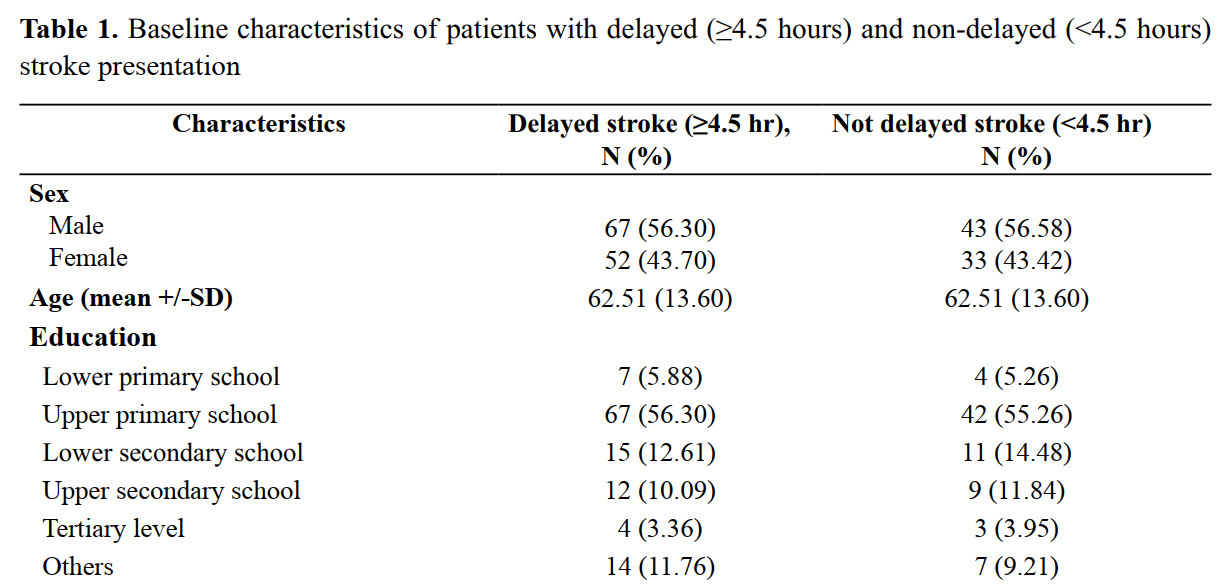
Methods: We conducted an ambispective observational cohort study of 195 patients with acute ischemic stroke admitted between January 2023 and May 2024, incorporating both retrospective medical record reviews and prospective patient interviews. We analyzed data on baseline characteristics, mode of transport, arrival time, and National Institutes of Health Stroke Scale (NIHSS) scores. Measures of association for delayed arrival (≥4.5 hours) were assessed using multivariate logistic regression to estimate adjusted odds ratios (aORs).
Results: Among 195 patients, 76 (38.9%) arrived within 4.5 hours of symptom onset, and 33 (16.9%) used EMS. Patients arriving within 4.5 hours had significantly lower discharge NIHSS scores compared with those arriving later (3.43 vs. 4.39, p = 0.010). EMS utilization was independently associated with a lower likelihood of delayed hospital arrival (aOR = 0.11, 95% CI: 0.02–0.81, p = 0.030). Additionally, patients with timely arrival demonstrated a greater reduction in mean NIHSS score compared to those with delayed arrival (mean difference in score improvement: 0.96 points, 95% CI: 0.23–1.69).
Conclusion: Early hospital arrival within 4.5 hours is associated with better stroke outcomes, yet the majority of patients still present late. EMS use is independently associated with reduced prehospital delay but remains underutilized.
Downloads
Metrics
References
Feigin VL, Brainin M, Norrving B, Martins S, Sacco RL, Hacke W, et al. World Stroke Organization (WSO): Global Stroke Fact Sheet 2022. Int J Stroke. 2022; 17: 18-29. DOI: https://doi.org/10.1177/17474930211065917
Tiamkao S, Ienghong K, Cheung LW, Celebi I, Suzuki TKA. Stroke incidence, rate of thrombolytic therapy, mortality in Thailand from 2009 to 2021. Open Access Maced. J Med Sci 2022; ; 10: 110-5. DOI: https://doi.org/10.3889/oamjms.2022.8051
Betts KA, Hurley D, Song J, Sajeev G, Guo J, Du EX, et al. Real-world outcomes of acute ischemic stroke treatment with intravenous recombinant tissue plasminogen activator. J Stroke Cerebrovasc Dis 2017; 26: 1996-2003. DOI: https://doi.org/10.1016/j.jstrokecerebrovasdis.2017.06.010
Smitasiri T, Jantararotai W. Outcomes in acute ischemic stroke patients treated with intravenous recombinant tissue plasminogen activator in Chonburi Hospital. CHJ 2021; 46: 195-204.
Rakchue P, Poonphol S. Factor influencing prehospital delay among acute ischemic stroke patients in Rajavithi Hospital. J Thai Stroke Soc 2019; 18: 5-13.
Wannarong T, Chotik-anuchit S, Nilanont Y. Factors associated with hospital arrival time in acute stroke. J Med Assoc Thai 2019; 102: 547-53.
Al Khathaami AM, Mohammad YO, Alibrahim FS, Jradi HA. Factors associated with late arrival of acute stroke patients to emergency department in Saudi Arabia. SAGE Open Med 2018; 6: 2050312118776719. DOI: https://doi.org/10.1177/2050312118776719
Powers WJ, Rabinstein AA, Ackerson T, Adeoye OM, Bambakidis NC, Becker K, et al. Guidelines for the early management of patients with acute ischemic stroke: 2019 Update to the 2018 guidelines for the early management of acute ischemic stroke: A guideline for healthcare professionals from the American Heart Association/American Stroke Association. Stroke 2019; 50: e344- e418. DOI: https://doi.org/10.1161/STR.0000000000000211
Xirasagar S, Wu Y, Heidari K, Zhou J, Tsai MH, Hardin JW, et al. Does emergency medical services transportation mitigate post-stroke discharge disability? A prospective observational study. J Gen Intern Med 2020; 35: 3173-80. DOI: https://doi.org/10.1007/s11606-020-06114-4
Ekundayo OJ, Saver JL, Fonarow GC, Schwamm LH, Xian Y, Zhao X, et al. Patterns of emergency medical services use and its association with timely stroke treatment: findings from get with the guidelines-stroke. Circ Cardiovasc Qual Outcomes 2013; 6: 262-9. DOI: https://doi.org/10.1161/CIRCOUTCOMES.113.000089
de la Ossa NP, Sanchez-Ojanguren J, Palomeras E, Millan M, Arenillas JF, Dorado L, et al. Influence of the stroke code activation source on the outcome of acute ischemic stroke patients. Neurology 2008; 70: 1238-43. DOI: https://doi.org/10.1212/01.wnl.0000291008.63002.a5
Chen H, Wang J, Pan X, Zhang M. Effects of emergency medical services on timely treatment and outcome in stroke patients with intravenous thrombolysis among the severity of neurologic deficits: A retrospective observational study. Medicine (Baltimore) 2023; 102: e35053. DOI: https://doi.org/10.1097/MD.0000000000035053
Paesuwan N, Jantararotai W, Kongmeprasurd P, Tunsiri V, Kwangmaha C, Durongbhandhu T. The impact of emergency medical services on the treatment outcomes of stroke patients receiving the rt-PA administration. TJEM 2025; 6: 32-43.
Derex L, Adeleine P, Nighoghossian N, Honnorat J, Trouillas P. Factors influencing early admission in a French stroke unit. Stroke 2002; 33: 153-9. DOI: https://doi.org/10.1161/hs0102.100533
Reeves MJ, Prager M, Fang J, Stamplecoski M, Kapral MK. Impact of living alone on the care and outcomes of patients with acute stroke. Stroke. 2014; 45: 3083-5. DOI: https://doi.org/10.1161/STROKEAHA.114.006520
Pandian JD, Kalra G, Jaison A, Deepak SS, Shamsher S, Padala S, et al. Factors delaying admission to a hospital-based stroke unit in India. J Stroke Cerebrovasc Dis 2006; 15: 81-7. DOI: https://doi.org/10.1016/j.jstrokecerebrovasdis.2006.01.001
Muengtaweepongsa S, Hunghok W, Harnirattisai T. Poor recognition of prompted treatment seeking even with good knowledge of stroke warning signs contribute to delayed arrival of acute ischemic stroke patients in Thailand. J Stroke Cerebrovasc Dis 2014; 23: 948-52. DOI: https://doi.org/10.1016/j.jstrokecerebrovasdis.2013.07.044
Wongwiangjunt S, Komoltri C, Poungvarin N, Nilanont Y. Stroke awareness and factors influencing hospital arrival time: a prospective observational study. J Med Assoc Thai 2015; 98: 260-4.
Downloads
Published
How to Cite
Issue
Section
License
Copyright (c) 2026 Journal of Southeast Asian Medical Research

This work is licensed under a Creative Commons Attribution-NonCommercial-NoDerivatives 4.0 International License.
The Journal of Southeast Asian Medical Research will hold the copyright to all published articles. The publisher's production department handles copyright forms once a manuscript is accepted and scheduled for publication.