BUILDING SELF-CONFIDENCE IN EVIDENCE APPRAISAL AMONG PRECLINICAL MEDICAL STUDENTS THROUGH ABSTRACT INTERPRETATION: AN EXPERIENCE FROM AN INTRODUCTORY EPIDEMIOLOGY COURSE
DOI:
https://doi.org/10.55374/jseamed.v10.305Keywords:
Medical Education, Evidence-Based Medicine, Epidemiology, Self-AssessmentAbstract
Background: Evidence-based medicine (EBM) requires clinicians to identify, appraise, and apply research evidence in clinical decision-making, making research literacy a foundational competency in undergraduate medical education. However, these skills are rarely explicitly taught in medical curricula, leaving students underprepared to engage with scientific literature. Objective: To evaluate changes in self-perceived academic reading competence among second-year medical students following a structured abstract interpretation assignment embedded in a short, intensive introductory epidemiology course.
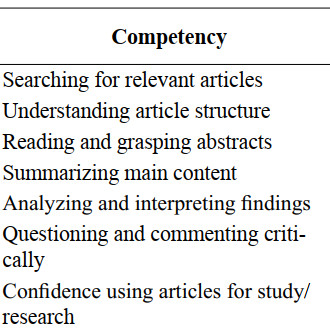
Methods: A one-group pre–post design was employed with 105 second-year (preclinical) medical students in a compulsory one-credit epidemiology course in Bangkok, Thailand. The pre- and post-course assessments were administered approximately one week apart. Each student was assigned a peer-reviewed article, required to interpret the title and abstract using the PICO framework, and deliver a structured presentation assessed by a standardized rubric. Students’ abstract interpretation performance was additionally assessed using the overall score from the faculty-assessed presentation rubric. A seven-item self-assessment instrument covering literature searching, article comprehension, summarization, critical analysis, and research confidence was administered before and after the course on a five-point Likert scale (maximum score = 35). Group differences were evaluated using independent-samples t-tests with Cohen’s d as the effect size.
Results: Internal consistency was high at both time points (pre: α = 0.894; post: α = 0.924). The mean score for the abstract interpretation presentation was 7.20 (SD = 0.30) out of 7.50 points. The precourse mean total score was 24.14 (SD = 3.92; 69.0% of maximum). Following the course, the mean increased to 30.70 (SD = 4.13), a gain of 6.55 points (27.1%), which was statistically significant (t(208) = 11.80, p < .001) with a large effect size (Cohen’s d = 1.63). All seven competency items improved significantly (p < .001), with Cohen’s d values ranging from 1.17 to 1.51.
Conclusion: A structured, individually accountable abstract-interpretation assignment embedded in a brief, intensive epidemiology course was associated with significant increases in students’ selfperceived academic reading competence. These findings support integration of focused research literacy activities into early undergraduate medical curricula as a practical strategy for building EBM foundations.
Downloads
Metrics
References
Ilic D, Maloney S. Methods of teaching medical trainees evidence-based medicine: a systematic review. Med Educ 2014; 48: 124–35. DOI: https://doi.org/10.1111/medu.12288
Zee M, de Boer M, Jaarsma ADC. Acquiring evidence-based medicine and research skills in the undergraduate medical curriculum: three different didactical formats compared. Perspect Med Educ 2014; 3: 357–70. DOI: https://doi.org/10.1007/S40037-014-0143-Y
Kling J, Larsen S, Thomsen SF. The need for focused literacy training in the medical school curriculum: a cross-sectional study of undergraduate students. Shankar PR, editor. Education Research International 2017; 2017: 7273824. DOI: https://doi.org/10.1155/2017/7273824
Greenhalgh T. How to read a paper: The basics of evidence-based medicine. 5th ed. John Wiley & Sons; 2014. 285 p.
Sackett DL, Rosenberg WM, Gray JA, Haynes RB, Richardson WS. Evidence based medicine: what it is and what it isn’t. BMJ 1996 13; 312:71–2. DOI: https://doi.org/10.1136/bmj.312.7023.71
Gordis L. Epidemiology. 5th ed. Elsevier Saunders; 2014. 392 p.
Goldmann E, Stark JH, Kapadia F, McQueen MB. Teaching epidemiology at the under graduate level: considerations and approaches.Am J Epidemiol 2018; 187: 1143–8. DOI: https://doi.org/10.1093/aje/kwy055
Norman GR, Shannon SI. Effectiveness of instruction in critical appraisal (evidence-based medicine) skills: a critical appraisal. CMAJ. 1998; 158: 177–81.
Sasannia S, Amini M, Moosavi M, Askarinejad A, Moghadami M, Ziaee H, et al. Critical appraisal skills training to undergraduate medical students: A randomized control study. J Adv Med Educ Prof 2022; 10: 253–8.
Kennedy G, Rea JNM, Rea IM. Prompting medical students to self-assess their learning needs during the ageing and health module: a mixed methods study. Med Educ Online 2019; 24: 1579558. DOI: https://doi.org/10.1080/10872981.2019.1579558
Richardson WS, Wilson MC, Nishikawa J, Hayward RS. The well-built clinical question: a key to evidence-based decisions. ACP J Club 1995; 123: A12-13. DOI: https://doi.org/10.7326/ACPJC-1995-123-3-A12
R Core Team. R: a language and environment for statistical computing [Internet]. Vienna: R Foundation for statistical computing; 2024 [cited 2026 Jun 17]. Available from: https://www.r-project.org/
Revelle W. psych: Procedures for psychological, psychometric, and personality research [Internet]. 2026 [cited 2026 Jun 17]. Available from: https://cran.r-project.org/web/packages/psych/index.html
Torchiano M. effsize: Efficient effect size computation [Internet]. 2020 [cited 2026 Jun 17]. Available from: https://cran.r-project.org/web/packages/effsize/index.html
Unrau NJ, Rueda R, Son E, Polanin JR, Lundeen RJ, Muraszewski AK. Can reading self-efficacy be modified? a meta-analysis of the impact of interventions on reading self-efficacy. review of educational research. 2018; 88:167–204. DOI: https://doi.org/10.3102/0034654317743199
Zhang H, Hu X, He C, Wang L, Yang M, Lu D. A journal club format that combines literature reading and clinical cases is more conducive to improving senior undergraduate medical students’ overall competence. Adv Med Educ Pract 2025; 16: 279–86. DOI: https://doi.org/10.2147/AMEP.S491991
Knof H, Berndt M, Shiozawa T. Prevalence of Dunning-Kruger effect in first semester medical students: a correlational study of self-assessment and actual academic performance. BMC Med Educ 2024; 24: 1210. DOI: https://doi.org/10.1186/s12909-024-06121-7
Downloads
Published
How to Cite
Issue
Section
License
Copyright (c) 2026 Journal of Southeast Asian Medical Research

This work is licensed under a Creative Commons Attribution-NonCommercial-NoDerivatives 4.0 International License.
The Journal of Southeast Asian Medical Research will hold the copyright to all published articles. The publisher's production department handles copyright forms once a manuscript is accepted and scheduled for publication.